


E-MAX INLAY
- Digital diagnostics
- Gentle treatments
- Transparent treatment plan and pricing
Precision ceramic inlay
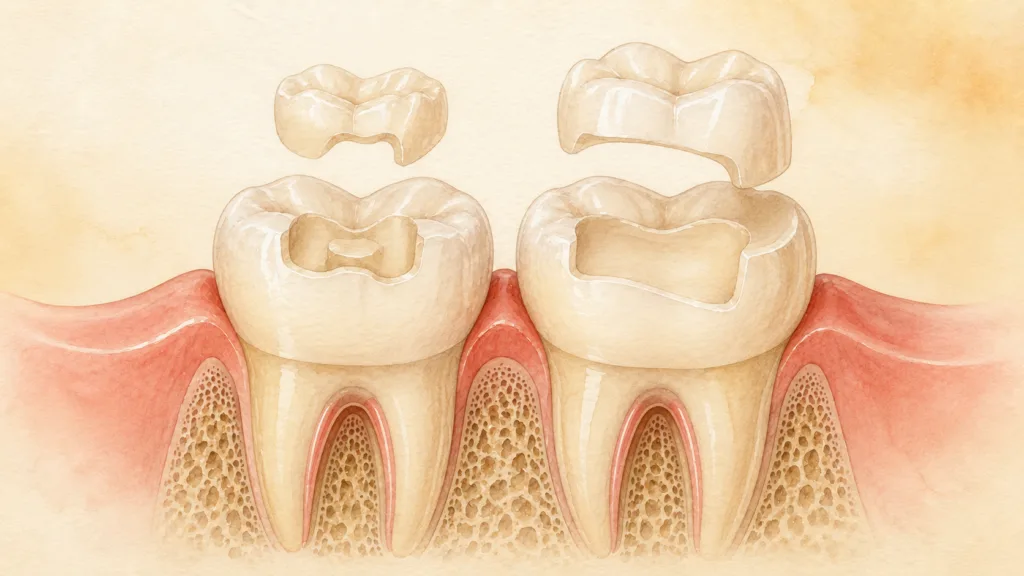
An e.max inlay/onlay is one of the most popular solutions in modern aesthetic dentistry. It is often described as the golden middle ground between a filling and a crown. While a simple filling is shaped by the dentist in the chair, an inlay is made by a dental technician under precise laboratory conditions, or milled from a single block using CAD/CAM technology.
What is e.max, and what makes the material special?
e.max is actually a brand name (made by Ivoclar); the material itself is lithium disilicate glass ceramic.
- Exceptional strength: This material is far more resistant to biting forces than traditional composite (plastic-based) fillings.
- Lifelike aesthetics: The ceramic’s light transmission is almost identical to natural tooth enamel. It does not look artificial — it blends seamlessly with the surrounding teeth.
- Colour stability: Unlike fillings, e.max does not stain over the years from coffee, tea or red wine.
When is it used?
It is recommended when decay or damage is already too extensive for a simple filling to hold securely, but enough tooth structure remains that the whole tooth does not need to be prepared for a crown.
- Large cavities: When a significant part of the chewing surface is missing.
- Replacing large old amalgam fillings: Amalgam can often crack the tooth walls; an inlay stabilises them.
- Broken tooth: If one of the cusps involved in chewing fractures, a filling would no longer withstand the load.
Why is it better than a regular filling?
- Tissue-friendly: It does not irritate the gums and is completely metal-free, so it is also safe for people with allergies.
- Precision (micron-level accuracy): Because it is made in the lab, the technician can perfectly shape the contact points between the teeth. Food is far less likely to get trapped between them.
- Long lifespan: While a large filling often needs replacing every 5–7 years, a well-made e.max inlay can last 15–20 years.
- Tooth-preserving: Less healthy tooth structure needs to be removed than for a crown.
How is it made?
-
Visit 1: The dentist cleans out the decay, shapes a special cavity, then takes an impression (traditionally or with a digital scanner). You then receive a temporary filling.
-
Lab phase: The dental technician fabricates the ceramic inlay, which is milled or pressed from a single block and individually stained to match your tooth colour.
-
Visit 2: The dentist bonds the inlay with a special high-strength adhesive (adhesive technique). This creates a chemical bond between the tooth and the ceramic, so the inlay effectively becomes part of the tooth.