Implantology
- CBCT planning
- X-Guide navigation
- Zirconia ceramic crown
A restoration that feels almost like the original
The implant is one of the great achievements of modern dentistry. It is not simply a “replacement”, but a solution that integrates biologically into the human body.
What exactly is an implant?
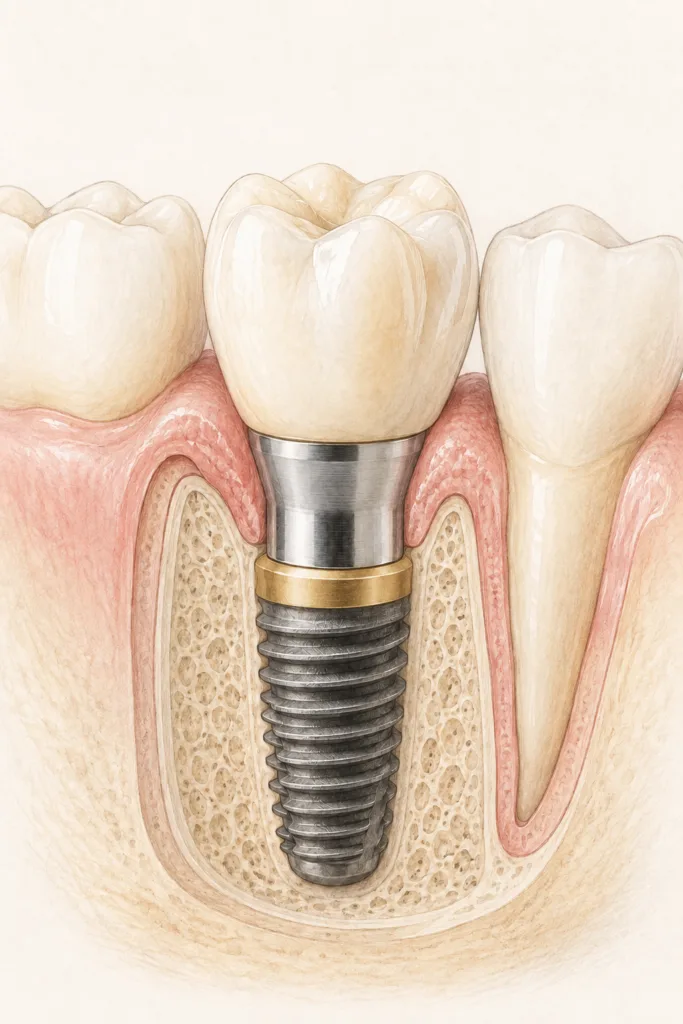
Imagine a tiny titanium screw with a specially treated surface that replaces the tooth root. Titanium is a biocompatible metal: the body does not try to reject it; on the contrary, bone cells attach directly to its surface and settle into its tiny pores. This is called osseointegration.
How is it different from a traditional bridge?
The implant stands independently — neighbouring teeth remain untouched.
- No grinding: With a traditional bridge, the two healthy teeth next to the gap must be ground down. With an implant this is not necessary.
- Bone protection: During chewing the implant transmits stimuli to the bone, preventing its resorption, which would otherwise inevitably occur with a missing tooth.
The treatment process step by step
-
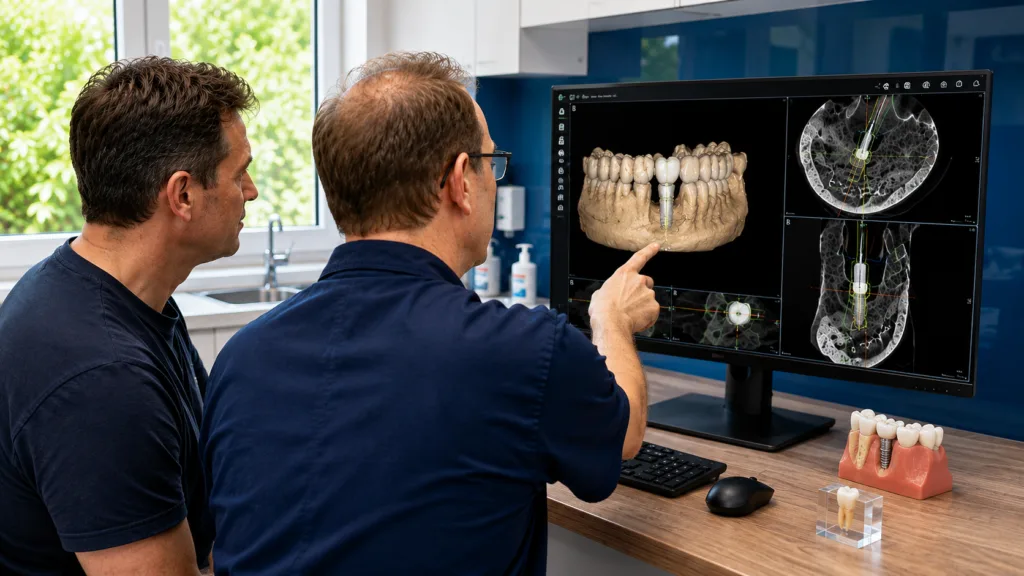
Planning: Based on a 3D dental X-ray (CBCT) we determine the implant position to millimetre accuracy. If an important anatomical structure lies near the gap, this imaging also helps us avoid it.
-
Placement: In a minor procedure we place the “screw”. It is completely pain-free and performed under local anaesthetic. With modern navigation we guide the clinician’s hand, while if needed the plan can also be adjusted during the procedure.
-
X-Guide (dynamic navigation): The clinician does not work through a rigid template — the machine guides their hand on the monitor. High-resolution cameras continuously track the drill and the patient’s jaw. If the head moves even minimally, the system follows immediately, so accuracy is maintained.
-
Healing time: Usually a 3–4 month period of patience while the implant “fuses” with the bone. We aim to preserve the original soft-tissue shape, or with custom forming tools create structures similar to the original.
-
Fitting the crown: Once the implant has osseointegrated, we screw on a component onto which the lifelike monolithic zirconia ceramic crown made by the dental technician is finally placed.
Who can receive an implant?
Almost anyone whose bone growth is complete. Even if there is little bone, bone grafting procedures exist today that can create a safe foundation.