Periodontology
- Periodontal disease treatment
- Root surface planing
- Periodontal regeneration
How can we lose even healthy teeth?
One of the dentist’s main tasks is to save teeth from decay and periodontal disease. Periodontology deals with the latter: the supporting foundation of the teeth and the health of the periodontium. Teeth are connected to the jawbone by a complex system. Among other things, this allows the extremely high chewing forces that hit the teeth not to cause permanent damage in the bone.
What works against stability: biofilm and tartar
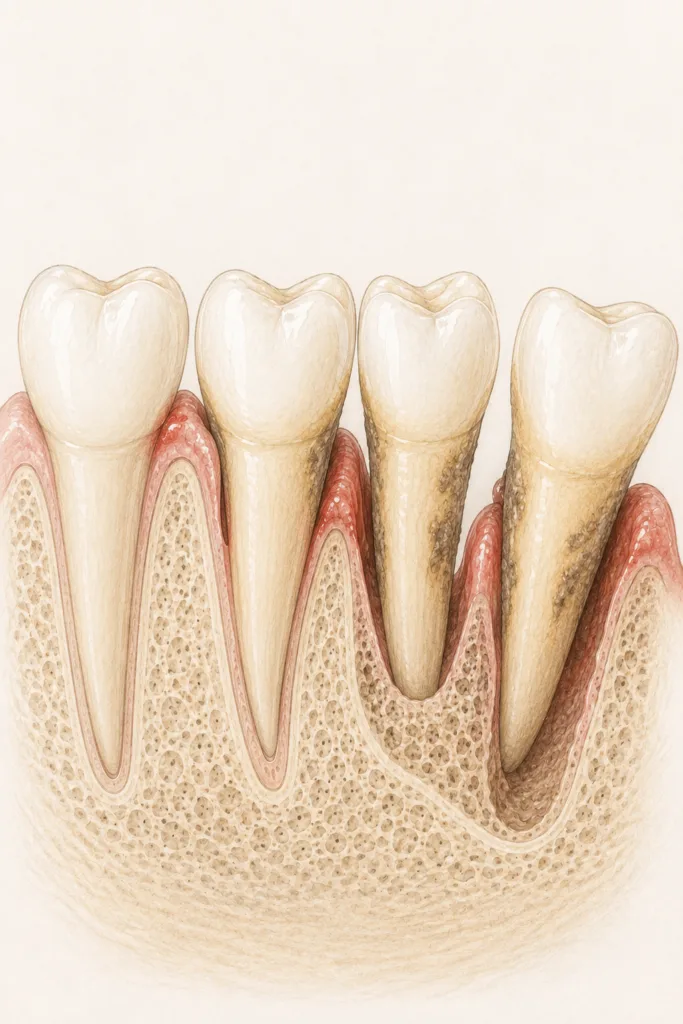
A plaque layer continually forms in the mouth and settles on the teeth, full of bacteria. If it is not removed regularly and thoroughly, minerals in the saliva harden it — at that point we call it tartar.
- Biofilm (plaque): A bacteria-rich layer on the teeth. Without regular, thorough removal it hardens.
- Tartar: A rough surface that irritates the gums and provides a perfect hiding place for bacteria that can no longer be removed with a toothbrush.
The course of inflammation — from bleeding gums to tooth loss
The process usually begins with bleeding gums. This is the body’s cry for help, which the patient also recognises immediately! If we do not intervene, the gum separates from the tooth and so-called pockets form. In these pockets bacteria undisturbedly destroy the fibres and bone that support the tooth. The difficulty is that this process is often painless for years, so the patient only notices when the tooth already starts to move.
How does treatment work? (Deep cleaning)
-
Diagnosis: Taking X-rays and measuring probing depth along the gum and tooth neck. With a fine, blunt-ended probe marked in millimetres we determine the depth of the gum pockets. By recording the values repeatedly, the stage and course of the disease can be followed.
-
Root surface planing: With specialised fine but sharp instruments and ultrasound we also remove deposits from the root surfaces beneath the gum tissue. This gives the gum a chance to “reattach” to the tooth, and for the inflammation to lessen or resolve.
-
Periodontal rehabilitation: Once the inflammation has resolved, rebuilding the lost periodontium can follow. Caution: many procedures promise complete healing, but periodontal regeneration has numerous prerequisites, and unfortunately rebuilding lost tissues is not possible in every case.
-
Stabilisation and reshaping: If the supporting structure cannot be regenerated, the gum contours can still be reshaped for better cleanability. Slightly mobile teeth can be bonded to each other and thus stabilised — extending their “lifespan” and making chewing more comfortable.
Connection to overall health
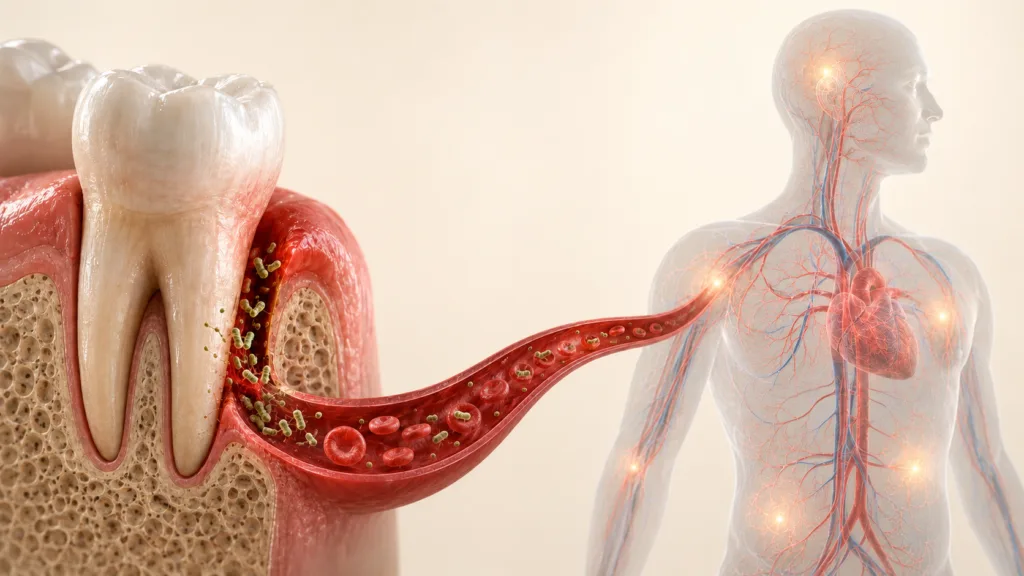
As with every disease, it can be said here too: prevention is better than treatment. It is important to know that periodontal disease does not remain a local problem. Through the pockets, bacteria can enter the bloodstream, reaching the farthest points of the body, where, settling and hiding from defence mechanisms, they can cause so-called focal diseases.