


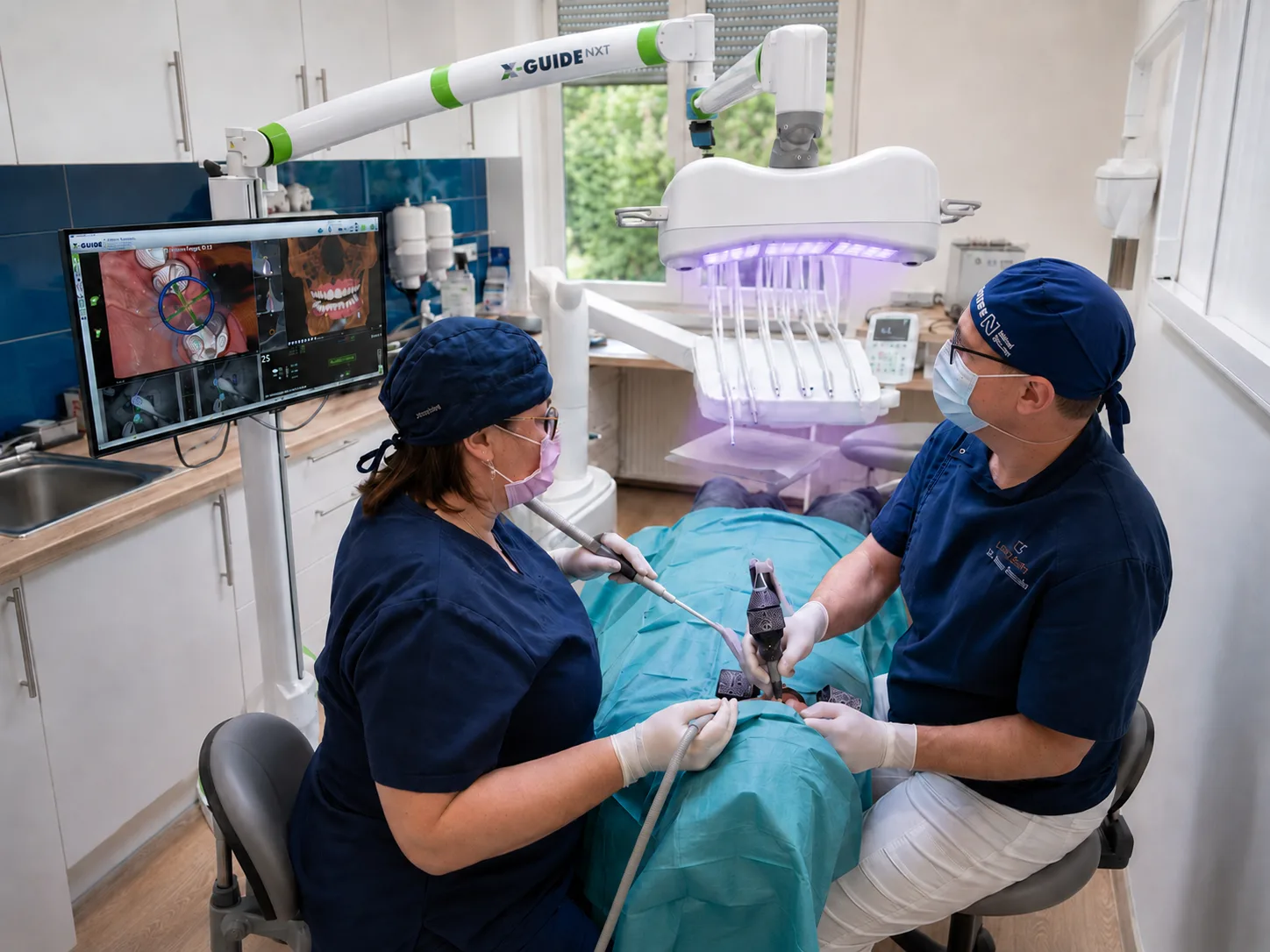
X-Guide navigated implantation
- Dynamic navigation
- Keyhole surgery
- Nobel Biocare
Navigated precision for your smile
Dental restoration today is no longer only about replacing missing teeth, but about restoring quality of life. Nobel Biocare, one of the world’s leading implantology companies, created the X-Guide system, which fundamentally changes what we thought about dental surgery.
What is the difference between conventional and X-Guide surgery?
Three approaches — and why dynamic navigation is the middle ground between digital planning and clinical freedom.
Conventional method
The clinician places the implant “freehand” based on the CT scan and experience. While expertise is there, the human eye cannot see beneath the bone during surgery.
Static guide
Until now, the most accurate method was a pre-fabricated plastic surgical guide. It is rigid, however: if during surgery the clinician sees that a millimetre shift would be better, the guide prevents that adjustment.
X-Guide (dynamic navigation)
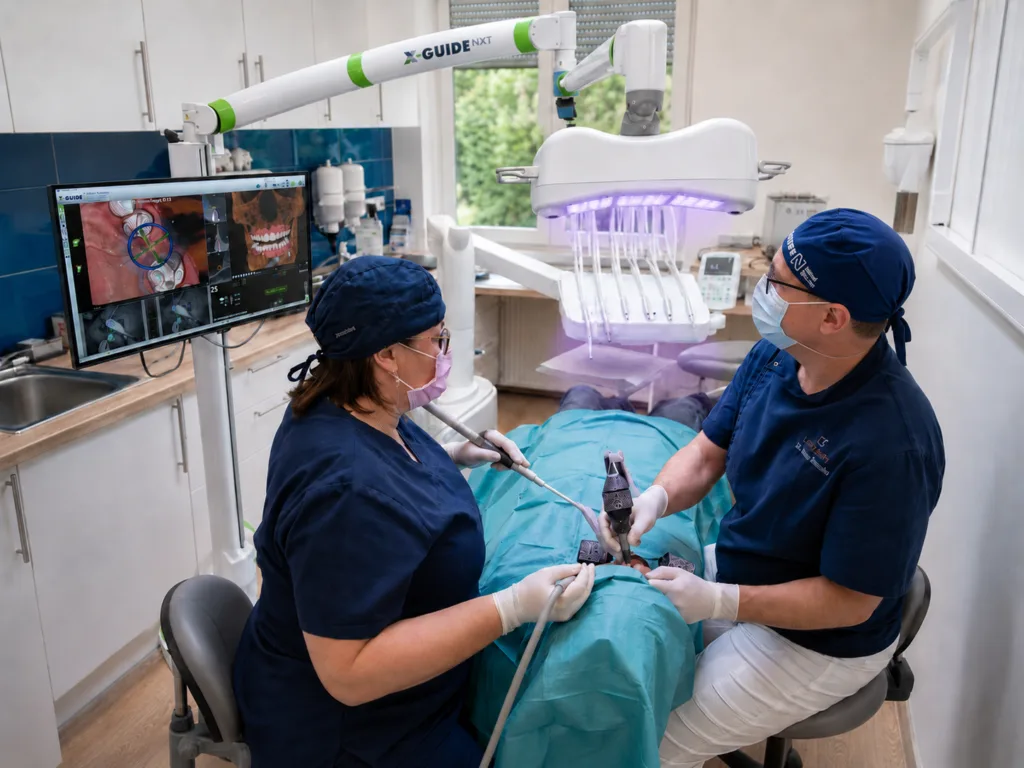
The clinician does not work through a rigid guide; instead, the system guides their hand via the monitor. High-resolution cameras continuously track both the drill and the patient’s jaw. If the head moves slightly, the system follows immediately — accuracy is maintained. If needed, the plan can be refined with the software right at the operating table.
How does the system see through the tissues?
X-Guide uses a special high-resolution camera system. We place small optical sensors on the patient and on the surgical instruments. These “eyes” send signals to the central computer several times per second, displaying the drill tip’s position in your jaw in real-time 3D. This means the clinician does not merely guess — they also see what is happening in the bone, without needing a large incision in the gum.
Why Nobel Biocare?
The Nobel Biocare name behind the technology is a guarantee of quality. They were pioneers of modern implantology, and X-Guide was developed to deliver maximum precision. When you choose X-Guide with us, you receive not only machine assistance, but one of the world’s most reliable dental ecosystems.
5 reasons patients love X-Guide:
-
“Keyhole surgery”: Often there is no need for wide gum flaps and sutures, so post-operative healing is measured in hours rather than days.
-
No waiting time: Manufacturing conventional guides can take days. With X-Guide, the time between planning and surgery can be substantially shortened.
-
Lower margin for error: The system alerts immediately if the clinician drifts even half a millimetre from the ideal path.
-
Comfort: You spend less time in the dental chair, as navigation speeds up the process.
-
Striking results: Before surgery we already show you on screen how the placed implant and your future tooth will look.
Frequently asked questions about X-Guide
The essentials in brief.
- Is this procedure more painful?: Quite the opposite! Because the technology is extremely gentle (minimally invasive), post-operative swelling and discomfort are significantly less than with conventional methods.
- Can it be used for everyone?: Yes, it can be used in almost every case. It is especially helpful when several teeth need replacing at once, where accuracy is even more critical.
Summary
X-Guide technology does not replace the dentist. It provides a level of confidence and accuracy that was previously unattainable. Your safety and satisfaction matter most to us — that is why we chose Nobel Biocare’s cutting-edge technology. Take the first step towards the perfect smile! Book a consultation where we will digitally plan your new teeth!